To see a World in a Grain of Sand
And a heaven in a Wild Flower,
Hold Infinity in the palm of your hand
And Eternity in an hour.
-William Blake in “Auguries of Innocence” cited by Robert A. Johnson, p. 4)
Robert Alex Johnson was an American Jungian analyst, therapist, author and lecturer. He was born in 1921 in Portland, Oregon, and died in 2018 at the ripe old age of 97 in San Diego, California. His calling to a vocation in analytical psychology began with an invitation to study at the C. G. Jung Institute in Zurich, Switzerland, by one of its founders when the school was founded in 1948 by Carl Jung’s devoted followers at the time under Jung’s guidance. Beside his main occupations of psychological analysis, writing and lecturing, Robert Johnson was passionate about Baroque music, the organ and the harpsichord.
This is the first book ever that I wish to write about and one of the very few books I have read twice. The written language in this book is simple and straightforward, literarily accessible to anyone with a moderate command of English. Nevertheless, the illuminating ideas as well as fascinating stories in this memoire have life-changing implications. If I have to describe Robert Johnson’s life in one word, it would be ‘miraculous.’ Indeed, the major events taking place in the course of his life are most unlikely to happen, starting with his extremely close encounter with death in a road accident at the age of eleven. His individual experiences are thus unique, which led to a singular trajectory in a maturing process miraculously aided by mystical visions and synchronous events. On the other hand, the big picture of Johnson’s life carries a universal human theme: “It seemed like I had to learn everything the hard way” (p.87).
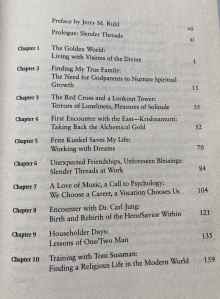
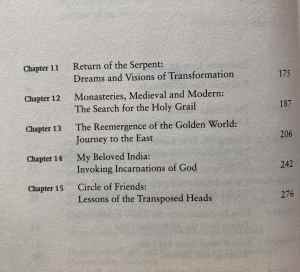
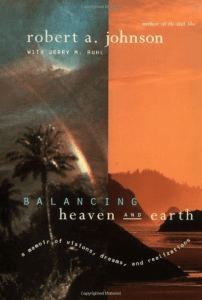
Between Heaven and Earth recounts the unfolding of major events and encounters in the author’s life as well as how they helped his consciousness evolve as he struggled to find his vocation and a sense of belonging in American society. Johnson was born a shy, introverted and sensitive personality into a family where his parents were not interested in knowing how he felt. His parents got divorced when he was young, and he was primarily nurtured by his maternal grandmother. Not only did he feel misunderstood in his birth family, but Johnson also struggled with existential loneliness as an introvert in an American cultural environment that highly values extroversion. Although he experienced major ups and downs and many twists and turns of fate, Johnson’s life had a happy ending.
Due to being a misfit in the mainstream culture, Robert Johnson suffered from an ego-driven young life burdened with feelings of being inadequate, lonely and lost. Through tremendous struggles and the benevolent guiding hand of Fate, or “the slender threads” as called by the author, Johnson ended up enjoying a professionally and emotionally fulfilled, Self-centered, mature old age amidst a loving circle of friends and admirers. According to Carl Jung, whereas the ego is the center of control that is limited in its scope of understanding and operates mostly out of impulses, the Self comes from a place of higher intelligence in the center of one’s being. In other words, the Self is a totality of being encompassing not only the ego and its shadow but also an evolved consciousness together with a subconsciousness that taps into the cultural, moral and spiritual heritage of humankind.
The main struggle for Johnson was to learn to live fruitfully in the earthly realm after his wondrous experiences of the heavenly realm, or “The Golden World” as termed by the author, at the tender age of eleven and once again as a young man. These seemingly surreal yet extremely vivid experiences haunted him and propelled him into the spiritual direction of life. The result is that Johnson constantly tried to balance the spiritually seeking aspect of his psyche with the material needs of living a human life in a highly specialized and technologically focused American society.
This book is a gem for spiritual seekers like me who are hungry for eclectic psychological, philosophical and religious insights. I read the book twice to try to commit to my memory psychological and philosophical concepts explored and postulated by Carl Jung such as the four typologies of personality and the differentiation between the ego and the Self. I also wanted to memorize for my own musings all the cultural and religious insights gathered by Robert Johnson during his travels and maturing process. I was ecstatic and grateful to come across Jung’s perspectives on the meaning of life and on the essential spiritual requirement for the survival of civilization. Interwoven with life lessons espoused by Western spiritual giants are age-old wisdom from Eastern religious and spiritual traditions owing to Johnson’s deep connection with India.
Last but not least, I enjoyed reading about a remarkable life told in a simple and sincere manner. I am able to relate to many elements of Johnson’s life since I am too a misfit in my original family and culture. In fact, I am a misfit in most social settings I have found myself in so far. In America, my adopted country, I thought I have found a home where I would actually be understood among like-minded individuals. As it turned out, after almost two decades of living here, I find myself not fitting in with this technology-obsessed, fast-paced society and its aggressive, superficial, frenetic ways of functioning. Reading this book has given me hope in my capability to grow and mature as a human being who is learning to function from a center of higher intelligence that has been guiding me to walk a path that is uniquely my own.